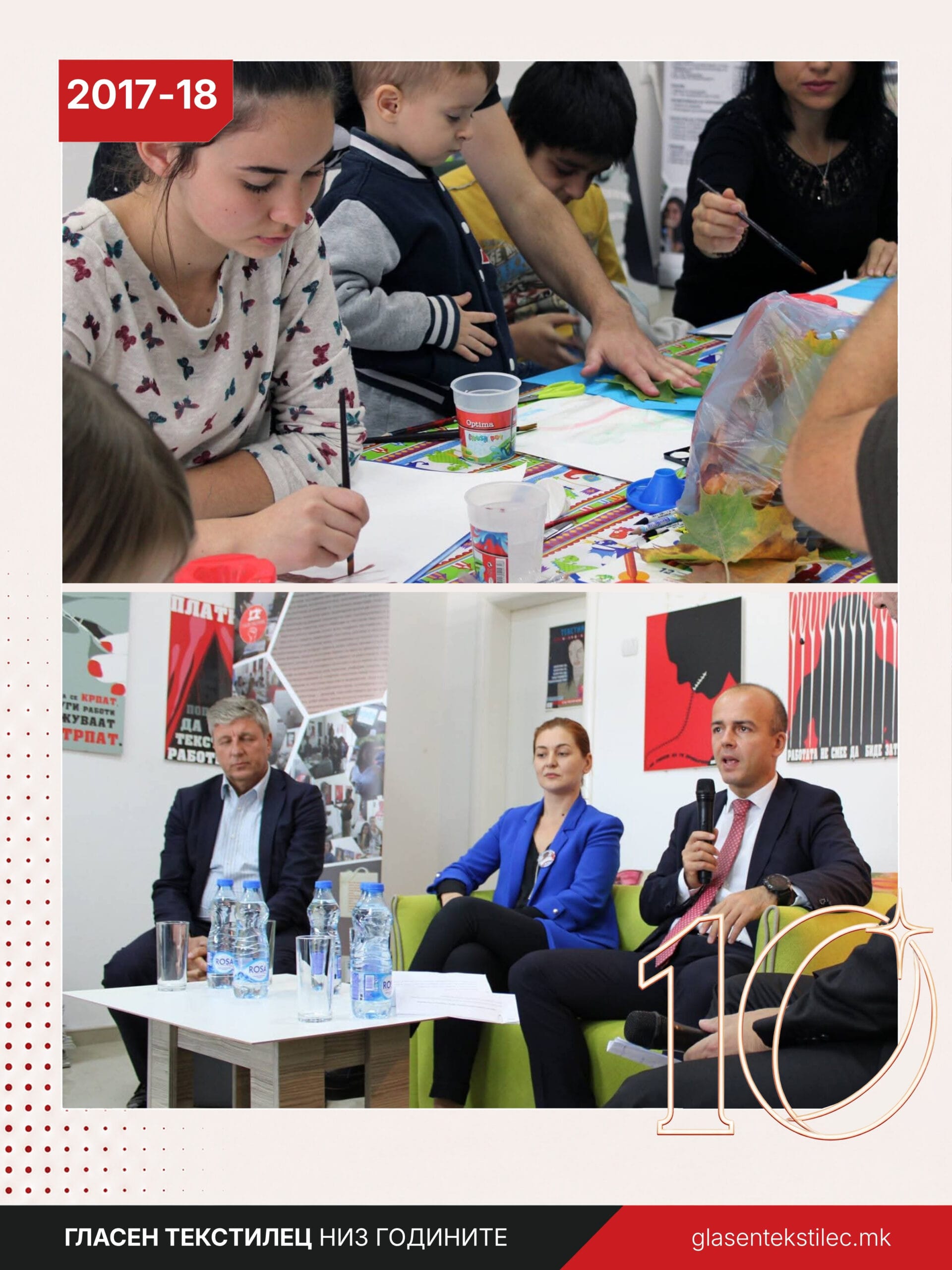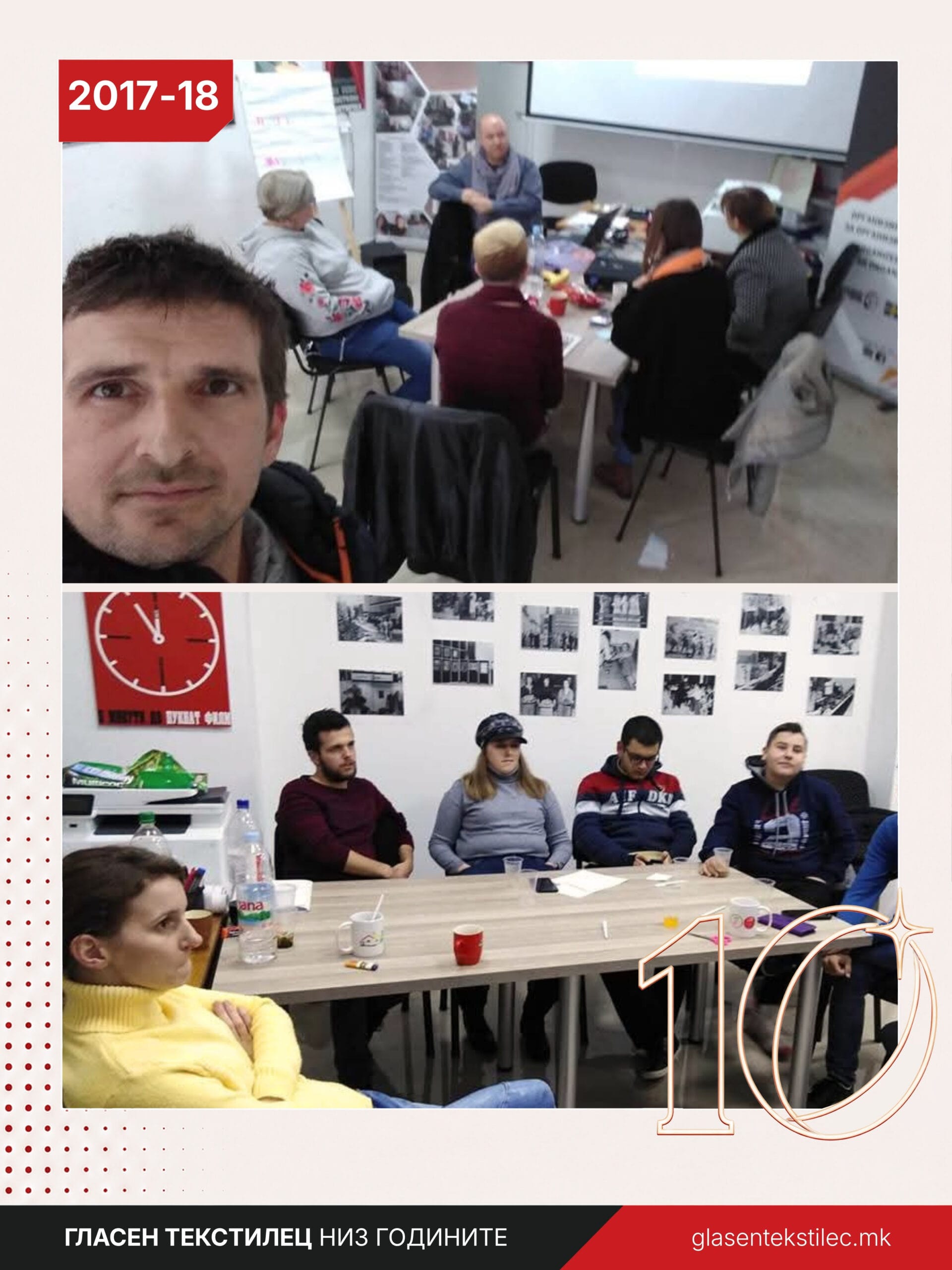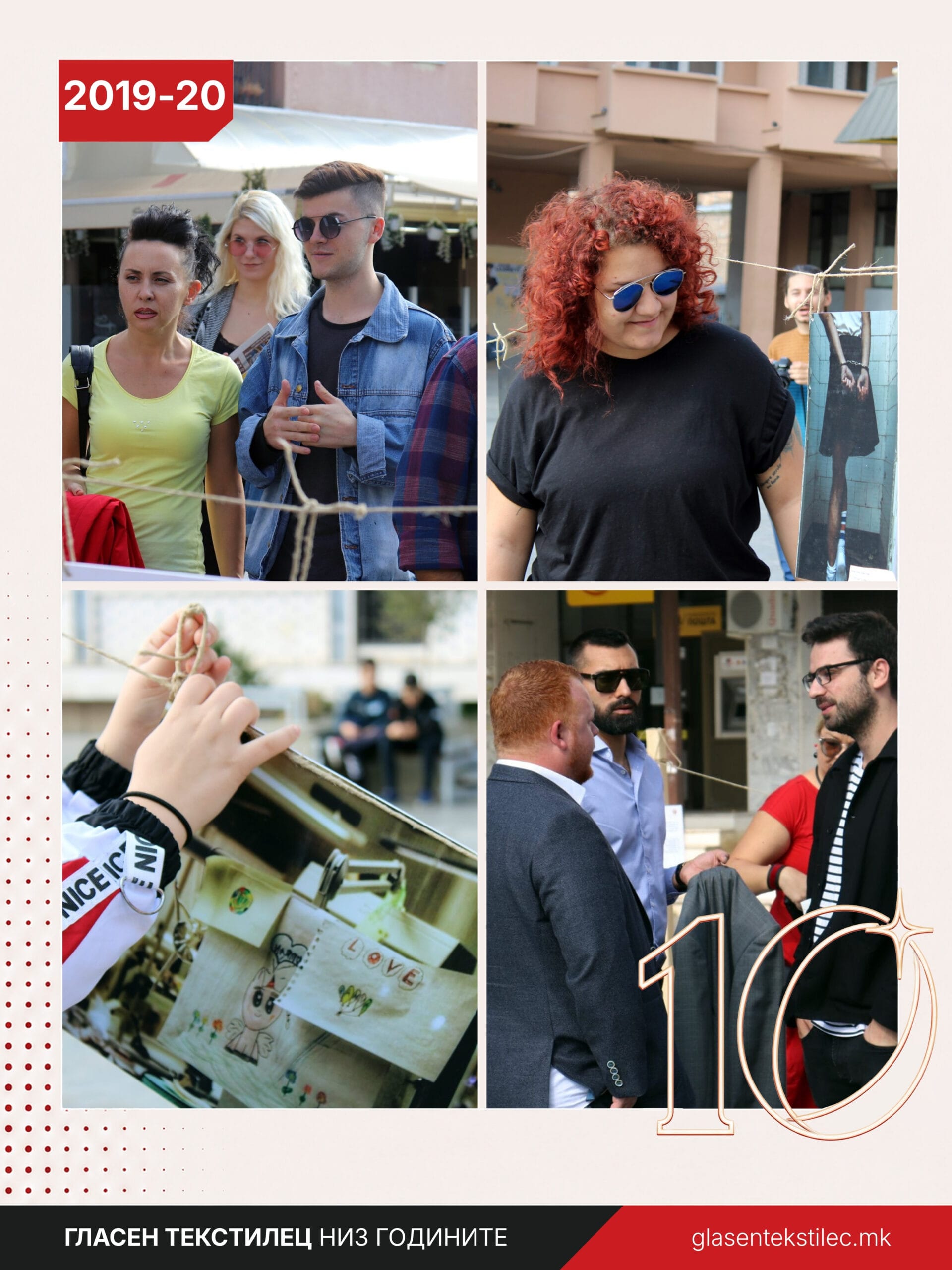


Ten years ago, a story began, born from the need to hear the voices of those who had been silenced for too long, namely textile workers. From that need, from the courage to speak out publicly about injustices, and from the belief that change is possible, Glasen Tekstilec was born.
Over the past ten years, Glasen Tekstilec has built a recognizable and strong story of solidarity, support, struggle and hope. A story whose center has always been people, workers, women, youth, families, citizens and all those who face challenges every day, but do not give up the right to a dignified life and work.
These are ten years filled with thousands of meetings, study visits, knowledge exchange, conferences, legal aid and court proceedings, advocacy, initiatives to improve the lives of citizens, education for youth, women and girls, awareness-raising campaigns, volunteer actions and joint steps forward. Throughout these ten years, Glasen Tekstilec has not only grown as an organization, but also as a community of activists. A community of people who believe in justice, equality, dignified work and the power of joint action. A community that has shown that activism is not just resistance, but the creation of new opportunities, new collaborations, new ideas and new spaces for participation and action.

A particularly important place in this ten-year story is occupied by Textiliada: an event that over time has grown into a symbol of struggle, solidarity, culture, art and togetherness. Textiliada has become a place where the voices of workers, activists, citizens, partners and friends meet; a place where important issues are raised with decision-makers, experiences are shared, new alliances are created and the perseverance of all those who believe in a better tomorrow is celebrated.


Over the years, the organization has developed and grown stronger thanks to the support and trust of numerous donors, including the Olof Palme International Center, The Kvinna till Kvinna Foundation, Reactor – Research in Action, the Kosovo Women's Network, SMART Balkans, The European Endowment for Democracy (EED), the Open Society Foundation – Macedonia, the Helsinki Committee for Human Rights and UN Women, the Municipality of Shtip, Civica Mobilitas and Switzerland, as well as numerous international and national partners, institutions, volunteers, activists and friends.
Their support was not just support for activities and projects, but support for a vision – a vision for a more just, more humane, and more solidary society.
Today, as we celebrate ten years of existence, we are not just a number behind us. We are ten years of courage, perseverance, and growth behind us. We are hundreds and thousands of people whose lives, experiences, and voices have shaped this organization. We are small and large victories, lessons learned, partnerships built, and trust created.
Glasen Tekstilec today is much more than an organization. It is a symbol of resistance and hope. A space where the voice of the individual gains strength through togetherness. A place where injustice is named and solidarity is transformed into action.
Ten years later, we continue even stronger, even louder, and even more determined, because we know that every change begins with a voice, and when many voices come together, the community, society, and the future change.
A decade dedicated to workers' rights
When I look back on the past ten years, it is difficult to summarize in a few sentences everything we have been through as "Voice Textile Worker". From an initiative created by the real and everyday problems of textile workers, we have grown into an organization that today works to protect and promote workers' rights and is recognizable as part of the civil and labor movement in North Macedonia. Our beginnings are in 2016. Back then, the problems were clear and visible everywhere around us, low wages, overtime and unpaid work, poor working conditions and workers who very often did not know what rights they were entitled to and where they could seek help.

In 2017, we strengthened our work through an association created by textile workers and human rights activists. Even then, we knew that we did not want to just react to individual injustices. We wanted to make the problems that workers face every day visible and talk about them locally, nationally, and internationally. From the very beginning, one of our most important goals was for workers to have access to information, free legal aid, and mechanisms through which they could truly protect their rights.
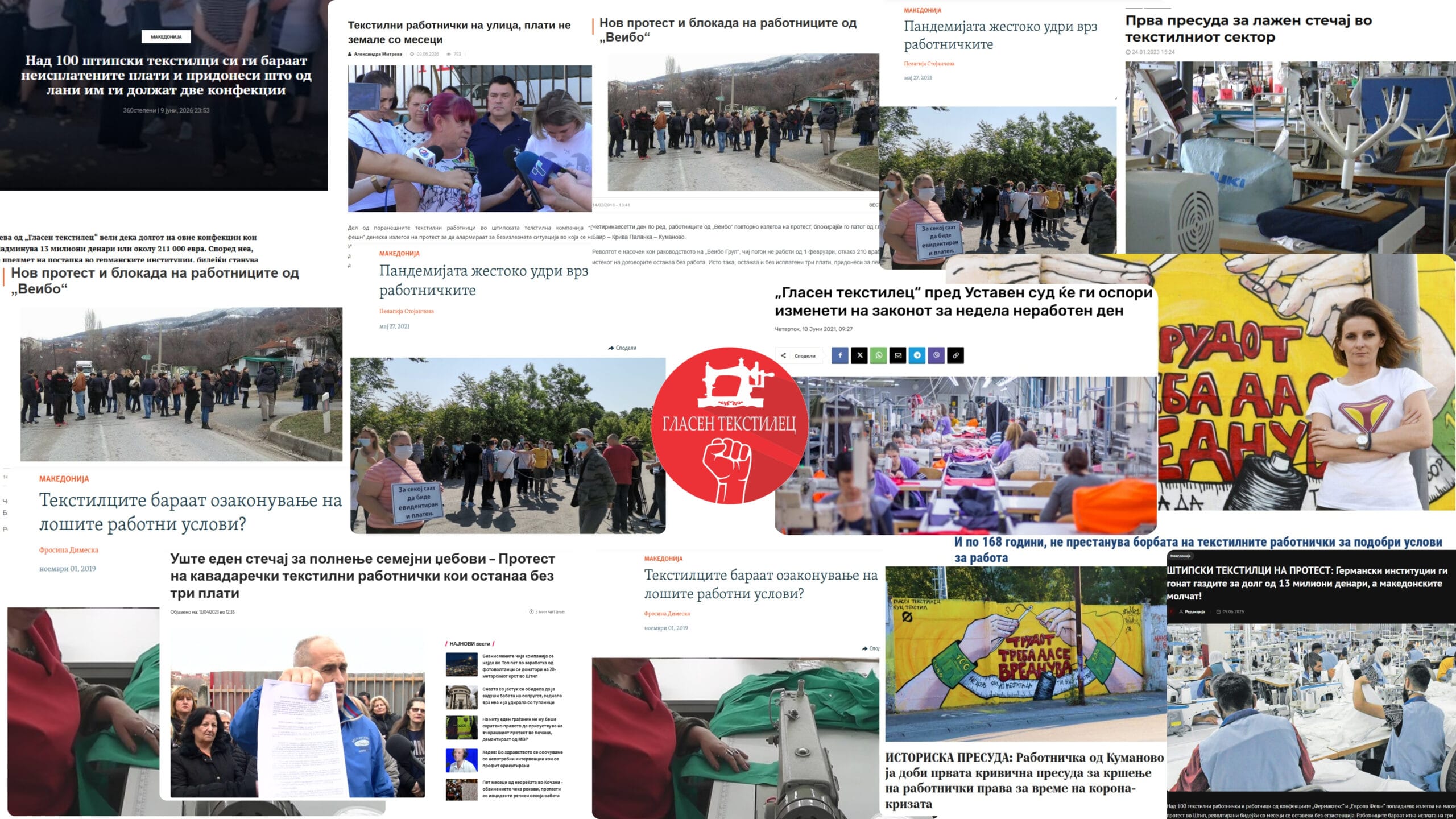
Over the years, our work has expanded. From the textile, leather and shoe industries, we have also started working with workers from the wider private sector. In addition to direct legal support, we have increasingly become involved in public advocacy, worker organizing, gender equality, economic empowerment and good governance. These are areas that remain an important part of our work today. Free legal aid and direct support for workers are among the most recognizable segments of "Glasen Tekstilec". As early as 2021, we could say that over a period of three years, we had brought 250 cases related to workers' rights to court, and all proceedings that had been completed by then had been resolved in favor of the workers. The COVID-19 pandemic was a particularly difficult period. The textile sector was severely affected by layoffs, termination of contracts and numerous violations of workers' rights. During that period, more than 12,000 workers received support through "Glasen Tekstilec". But the need for legal protection did not end with the pandemic. On the contrary, the scope of our work continued to grow. In the 365 days until May 2024 alone, we provided free legal aid to 5,369 workers. Today, we have more than 400 court cases related to unpaid overtime, work during holidays, work on Sundays, and other violations of workers' rights. For me, these numbers have never been just statistics. Behind every case is a person. A worker who has been waiting for months to be paid what she earned. A worker who did not know who to turn to. A family that depended on one salary. That is why individual legal protection has over time become a broader fight against problems that are constantly recurring. In addition to direct assistance to workers, in recent years we have constantly tried to include labor issues in public policies. We were among the most vocal initiators of the request to make Sunday a weekly rest day, an issue that later became part of national legislation. And when that right was introduced, we did not stop reacting to the exceptions and attempts to reduce its scope. We also included the voice of workers in the debates on the minimum wage, paid labor, K-15, occupational safety and health, mobbing, discrimination and dignified working conditions. Over the years, there have been cases that have shown how important it is not to give up. In 2023, the Basic Court in Shtip ruled for the criminal offense of "intentionally causing bankruptcy" in a case from the textile sector. It was a significant moment in the fight for employer liability. In 2024, after a long public and legal battle in the case of 69 former textile workers from Kavadarci, the Court of Appeal overturned the first-instance verdict that rejected their claim for unpaid wages and ordered the workers to pay around 20,000 euros in court costs. The case was returned for re-determination. Such moments remind us why it is important for workers to have someone who will stand by them even when the proceedings are long, difficult and uncertain. But our work has never been just legal. In parallel, we invested in education, information and awareness-raising among workers, young people and the general public. We went to the field, organized trainings and public debates, conducted research and campaigns, protested, talked to institutions and cooperated with domestic and international organizations. We wanted workers' rights to stop being a topic that is only talked about when injustice occurs. We wanted them to become constantly present in the public space. "Textiliada" has a special place for me in these ten years. We started it in 2017 as a cultural-activist event through which we wanted to talk about labor, workers' rights and human dignity in a different way – through art, debate, testimonies and direct participation of workers. The first "Textile Festival" was held in Shtip on December 15 and 16, 2017. Today, in 2026, we celebrate its tenth edition. When I look at what "Voice Textile Worker" represents today, it is clear that we are much more than the initiative we started with. We have built a system of free legal and paralegal assistance. We have represented hundreds of cases before institutions and courts. We have supported thousands of workers. We have opened up issues that previously remained on the margins, initiated changes and created a space in which it is increasingly difficult for workers' problems to remain invisible. But behind every result there are people. There are workers who trusted us enough to tell us their problems. People who decided not to remain silent. Activists, members, volunteers, friends, partners and all those who have been part of this story at different times. That is why for me the ten-year anniversary is not just the birthday of an organization. It is the culmination of ten years of work, perseverance, advocacy, solidarity, hard battles, but also concrete results. Ten years ago, it all started with the need to hear the voices of textile workers. Today, that struggle is broader, but the essence remains the same: every worker should know their rights, be able to use them and, when they are violated, have a way to effectively protect them. And that is precisely why we continue.